
A Argentina, que está em meio a uma crise financeira cada vez maior, terá que esperar mais para conseguir pelo menos 150 caixas eletrônicos em Bitcoin, que devem ser instalados até o final deste ano.
Conforme relatado em outubro, a empresa norte-americana Odyssey Group planejava instalar 150 ATMs Bitcoin no país latino-americano totalizando 1.600 máquinas até o final de 2019. Além disso, outra empresa, a Athena Bitcoin, que montou o primeiro ponto de criptografia na Argentina, também afirmou que espera ter um total de 30 máquinas no país até o final de 2018.
No entanto, parece que o país não verá dezenas de novos caixas eletrônicos em Bitcoin tão cedo.
A Odyssey Group adiou seus planos e agora estima entrar no mercado durante os próximos seis meses, informou o Next Web, citando o CEO Sebastian Ponceliz. De acordo com o relatório, ele alega que a razão para adiar a atualização do Bitcoin ATM da Argentina deve-se ao banco central do país e aos parceiros do mercado local da organização que supostamente pediram à empresa para ajustar “todos os requisitos legais e técnicos” exigidos. Pelas partes acima mencionadas.
No entanto, o relatório ressaltou que a empresa já fez várias promessas que ainda não se concretizaram. Em setembro de 2017, a subsidiária da empresa, a Octagon, planejava instalar 250 caixas eletrônicos criptografados em Buenos Aires até outubro. Enquanto em maio de 2018, Ponceliz anunciou que sua empresa havia chegado a um acordo com o banco central da Argentina para a implantação de 4.000 máquinas. Além disso, na mesma entrevista, o CEO afirmou que 200 caixas eletrônicos haviam sido instalados no país latino-americano. Mas isso não aconteceu, de acordo com a Coin ATM Radar, que mostra apenas quatro pontos de criptografia ativos no país, todos instalados pela Athena. No momento da publicação, Athena não respondeu a um pedido de comentário.
No entanto, o fato de as moedas fiduciárias tenderem a ser mais voláteis na América Latina traz "uma tremenda oportunidade de adoção em toda a região", segundo alguns investidores. Por exemplo, o OKGroup , o dono da maior troca de criptografia para criptografia , a OKEx , entrou na região por meio de sua OKCoin , que oferece seus serviços em mais de 110 países.
“À medida que o valor da moeda fiat da Argentina permanece incerto, a nossa esperança é que podemos ajudar a trazer alguma estabilidade para a economia do país, fornecendo argentinos com uma variedade de opções criptomoeda," representante latino-americano de OKCoin, Pablo Magro, disse Cryptonews.com no início Novembro.
Ambitious Plans for Bitcoin ATMs in Argentina Postponed
By Hyan Furtado

Depois dos últimos dias de vendas pesadas, os mercados de criptografia estão novamente no verde hoje. Com exceção do Bitcoin Cash , seu novo parente Bitcoin SV e EOS , todas as 20 maiores moedas estão vendo ganhos na manhã de quarta-feira.
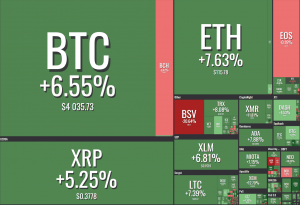
Parece que os compradores mais uma vez atingiram os mercados, depois que as vendas trouxeram os preços da maioria das moedas para níveis que alguns considerariam “baratos” novamente. Isso acontece ao mesmo tempo em que uma série de desenvolvimentos noticiosos positivos foi revelada em relação à tão esperada entrada institucional na criptografia.
Vamos passar por eles um por um:
Futuros de Nasdaq e Bitcoin
A Nasdaq , segunda maior bolsa de valores do mundo em capitalização de mercado, pretende permitir a negociação de futuros do Bitcoin no primeiro trimestre de 2019, apesar do crash do mercado este ano, informou a Bloomberg, citando “duas pessoas familiarizadas com o assunto”. Os futuros serão baseados no preço do Bitcoin em várias bolsas spot, conforme compilado pela VanEck Associates Corp. , de acordo com o relatório.
"Somos meio agnósticos no preço"
Este comentário foi proferido por Jeffrey Sprecher, fundador e CEO da Intercontinental Exchange (ICE), quando perguntado sobre o recente declínio nos preços do bitcoin durante a conferência de Consenso da CoinDesk em Nova York na terça-feira. A ICE é a empresa-mãe e uma importante patrocinadora da nova plataforma Bakkt , que deve trazer mais liquidez institucional ao mercado de bitcoin.
Sprecher foi acompanhado no palco pelo CEO da Bakkt, Kelly Loeffler, que repetiu o mesmo sentimento dizendo que "o preço está sendo expresso, mas há muita falta de infra-estrutura e casos de uso", sugerindo que os preços podem se recuperar assim que a "infraestrutura perdida" for colocada no lugar, de acordo com Coindesk.
No entanto, conforme relatado, a data de lançamento da plataforma Bakkt será adiada para 24 de janeiro de 2019, a partir de um lançamento originalmente programado em dezembro deste ano.
A criptografia está "aqui para ficar": El-Erian
Os investidores de varejo em criptografia estão se tornando mais razoáveis, enquanto instituições estão começando a se firmar no longo prazo, disse Mohamed El-Erian, assessor econômico-chefe da Allianz, gigante de seguros e investimentos , durante a mesma conferência na terça-feira.
O altamente conceituado economista disse ainda acreditar que as criptomoedas "existirão" e que elas se tornarão "cada vez mais difundidas", informou a Reuters. No entanto, ele também acrescentou uma palavra de cautela a alguns dos mais sinceros entusiastas da criptografia, dizendo que "[criptocorrências] não serão tão [as] dominantes quanto alguns dos primeiros adeptos acreditaram que fossem".
Bitcoin é "parecido com o dólar": SEC
Enquanto isso, na mesma conferência, o presidente da Securities and Exchange Commission (SEC) dos EUA, Jay Clayton, reiterou a posição da SEC de que o bitcoin não é uma garantia.
"Um ativo como o bitcoin, onde ele é projetado para substituir as moedas soberanas, determinamos que ele não tem os atributos de um título", disse Clayton, segundo o Yahoo Finance.
No entanto, quando se tratava do muito antecipado fundo negociado em bolsa baseado em bitcoin (ETF), os comentários de Clayton não foram tão positivos. Sobre a questão de uma possível aprovação do ETF, Clayton explicou que qualquer ativo em que um ETF se baseia deve estar "livre do risco de manipulação". Ele acrescentou que essa é "uma questão que precisa ser resolvida antes que eu me sinta confortável". aprovando um bitcoin ETF]. ”
Código de Conduta Criptográfica
E parece que a indústria de criptografia está tentando resolver esses problemas. Nos EUA, surgiu uma nova associação de criptografia que visa estabelecer um Código de Conduta para mercados emergentes de ativos digitais.
Dez empresas de serviços financeiros e tecnologia, incluindo a Galaxy Digital , a Paxos , a Genesis Global Trading, entre outras, lançaram a Associação de Mercados de Ativos Digitais (ADAM). Trabalharão com reguladores atuais e anteriores para fornecer regras para negociação, custódia e compensação eficientes. e liquidação de ativos digitais, de acordo com o anúncio. O Código de Conduta da ADAM incluirá diretrizes para integridade do mercado, gerenciamento de risco, KYC (saiba seu cliente) e AML (lavagem de dinheiro), custódia, manutenção de registros, compensação e liquidação, manipulação de mercado, proteção de dados e pesquisa, entre outros tópicos. .
Positive News and Buyers Return to the Crypto Market
By Hyan Furtado
Bitcoin price started a short term correction recently after a drop below USD 3,800. BTC/USD corrected above USD 4,000 and USD 4,100, but it struggled to clear the USD 4,200 barrier. Later, the price declined again and settled below USD 4,000, which is a bearish sign. Similarly, ethereum price failed to break an important resistance near USD 120 and started a fresh downward move. Ripple price also struggled to gain traction above USD 0.400, resulting in bearish moves. Going forward, if bitcoin and altcoins struggle to break key pivot levels, there could be yet another bearish wave below recent lows in the near term.
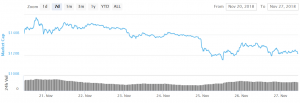
Source: coinmarketcap.com 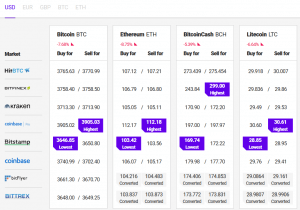
Total market capitalization
Bitcoin price
Recently, there was a recovery above the USD 4,000 resistance in bitcoin price , but buyers struggled to retain strength. BTC/USD topped near the USD 4,200 level and started a fresh downward move. It broke the USD 4,000 and USD 3,800 levels to move back in a bearish zone.
The price is down around 6% (UTC 08:30 AM) and it seems like it could decline further below the USD 3,750 and USD 3,620 support levels. In the worst case scenario, the price may even break the recent low and trade below the USD 3,500 level.
The price is down around 6% (UTC 08:30 AM) and it seems like it could decline further below the USD 3,750 and USD 3,620 support levels. In the worst case scenario, the price may even break the recent low and trade below the USD 3,500 level.
Ethereum price
Ethereum price recovered more than USD 15, but it struggled near a crucial resistance at USD 120. ETH/USD faced a solid selling interest near USD 120, which resulted in a bearish reaction.
The price declined below USD 115 and USD 110 and it is currently down around 6%. An immediate support is at USD 105, below which there is a risk of a downside break below the key USD 100 support. The main resistances on the upside are at USD 115 and USD 120.
The price declined below USD 115 and USD 110 and it is currently down around 6%. An immediate support is at USD 105, below which there is a risk of a downside break below the key USD 100 support. The main resistances on the upside are at USD 115 and USD 120.
Bitcoin cash and ripple price
Bitcoin cash ABC rallied above the USD 200 and USD 220 resistance levels. However, BCHABC failed to stay above USD 200 and later declined heavily. The price is currently trading near USD 180 and it seems like it could test the USD 170 support. On the other hand, BCHSV rallied above the USD 100 level and traded as high as USD 140. It is currently consolidating above USD 100 with positive moves.
Ripple price recovered above the USD 0.385 resistance, but it struggled to clear the USD 0.400 resistance. XRP/USD is down 5% to USD 0.358 and it could revisit the USD 0.340 support.
Ripple price recovered above the USD 0.385 resistance, but it struggled to clear the USD 0.400 resistance. XRP/USD is down 5% to USD 0.358 and it could revisit the USD 0.340 support.
Other altcoins market today
Many small cap altcoins declined recently more than 10%, including SRN, FCT, MITH, STEEM, ONT, MAID, REP, WAN, GNT and ODE. Out of these, SRN declined around 26% and FCT is down nearly 25%.
Overall, bitcoin price is back below the key USD 4,000 support, which is a bearish sign. If BTC/USD fails to jump above USD 4,000 and USD 4,200, there is a risk of more losses below the USD 3,500 level in the near term. Similarly, there could be an increase in selling pressure on altcoins like ethereum, ripple, BCH, neo and litecoin if they fail to start a fresh rebound in the next few hours.
_____
_____
Find the best price to buy/sell cryptocurrency:
Bitcoin and Altcoins Trimmed Gains
By Hyan Furtado
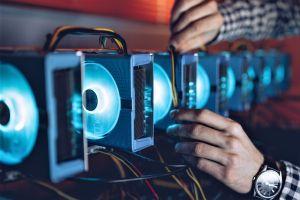
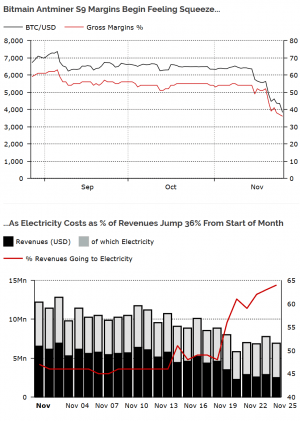
The current cryptocurrency price crash is taking its toll on miners in China and Russia, with media outlets in both countries reporting mass shutdowns and equipment sell-offs. However, some experts in both countries believe that fresh opportunities may well arise following the market panic.
Some are sensing a possible upside, and are choosing to stay in the game. Chinese media outlet Caixin quotes the COO of Chinese company Mining Sea, which operates farms in Yunnan, Sichuan and Inner Mongolia as stating, “We have yet to switch off our machines as we also offer financial products to help clients control for such risks.” The COO also stated miners could possibly “acquire more coins” now as rivals “have temporarily stopped running their machines.”
And Russian media outlet Kommersant quotes the co-founder of the ICG cryptocurrency fund as stating that although “the Russian home miner is gradually disappearing,” big businesses in the country are ready to step in with superior technology – perhaps leading to a second boom in mining.
However, for many it's still a challenging period and bitcoin miners are increasingly feeling the pressure to sell their coins.
Caixin quotes a mining industry insider as stating that some miners in the country have “halted operations” as Bitcoin prices have dropped below “shutdown price,” the level below which mining effectively ceases to be profitable.
F2pool, one of the largest mining pools in China, stated that Bitcoin prices had dropped below shutdown price for miners paying USD 0.05/KwH for electricity and using Bitmain’s Antminer S7, Avalon’s Miner A741 and the lower-frequency version of the USED Whatsminer M3+. F2pool officials also claimed, earlier this week, that between 600,000 and 800,000 Bitcoin miners have pulled the plug on their operations in the past two weeks.
Meanwhile, in Russia, Kommersant quotes the co-founder of mining farm operator and hardware maker RMC as stating mining farm facilities had “temporarily suspended activities at the request of project participants, as the cost of electricity currently exceeds the income made from mining.” The company says it will push ahead, however, with plans to build parts for new altcoin mining hardware.
Marketplace app Youla, Russia’s answer to eBay, has reported a 25% rise in the amount of mining equipment listings, as well as “a simultaneous drop” in bid prices, for both ready-made mining rigs and video cards. Youla noted that the terms “mining” and “Bitcoin” were now being searched for four times less often than at the beginning of the year – when Russia was in the grip of its mining boom.
____
____
China, Russia in Mining Panic – But Some See Silver Lining
By Hyan Furtado
Between 600,000 and 800,000 bitcoin miners have shut down since mid-November amid declines in price and hashrate across the network, according to the third-largest mining pool.
In an interview with CoinDesk, Mao Shixing, founder of F2pool, said his firm’s estimate takes into account the total network hashrate drop and the average hash power of older mining machines that are having a hard time generating profits.
According to data from blockchain.info, the bitcoin network’s entire hashrate, which captures the aggregated computing power on the world’s first blockchain, has dropped from around 47 million tera hashes per second (TH/s) on Nov. 10 to 41 million on Nov. 24 – an almost 13 percent decline.

Mao explained most miners that may have halted operations are likely those using older models, such as the Antminer T9+ made by Bitmain and AvalonMiner 741 by Canaan Creative. These miners have an average hash power of around 10 TH/s and are estimated to be losing money right now, according to F2pool’s miner revenue index.
In fact, the bitcoin hashrate on F2pool, which now accounts for about 11.4 percent of the total network, has also seen a decline of over 10 percent in recent weeks, Mao said.
“It’s hard to calculate a precise number of miners connected to us that had unplugged. But we saw over tens of thousands of them [shut down] in the past several days based on conversations we had with larger farms that we are in regular contact with,” he said, adding:
On Nov. 20, Mao shared via his Weibo social media account a photo of a man packing computer gear into boxes, with the caption “shutting down is not an option, now have to sell by the kilos.”
The post was widely taken to mean even mining equipment of recent vintage was being sold off by the kilogram in China, but Mao told CoinDesk he was half-kidding when he wrote it, explaining:
Winter Is Coming
Stepping back, Mao said there are multiple factors that contributed to the shakeout among miners, including the recent market decline that followed the bitcoin cash hard fork on Nov. 15; an increase in electricity costs in China; and the fact that Chinese manufacturers are still racing to upgrade their products, making older machines increasingly uncompetitive.
“All these factors are overlapping right now which led to this recent phenomenon,” Mao said.
As the winter comes in China, hydropower plants are experiencing a dry season when electricity costs have doubled from what they would have been in the summer when water was abundant.
During the summer, Mao said, electricity costs in China’s mountainous Southwestern region, where lots of mining farms reside, could go below 0.2 yuan, or $0.029, per 1 KW/h. But at this time of the year, that is going up to above 0.3 yuan ($0.043).
While other fossil fuel power stations, for instance in China’s Xinjiang province, may generate electricity at a steadier rate, the overall costs are still at least about 0.28 yuan ($0.04) per 1KW/h, Mao said.
As bitcoin’s price recently tanked to a 13-month low below $4,000, mining farms that have been using machines made in 2016 and 2017 with lower productivity just can’t break even, Mao added.
To be sure, the fact that mining farms have unplugged does not necessarily mean they are out of the game completely.
“Bitcoin mining is always a dynamically adjusted process,” Mao said, meaning when the hashrate drops, so does the mining difficulty. The latest data shows the bitcoin mining difficulty has already declined slightly by 5 percent within the past a few days.
This dynamically adjusted process could give those who haven’t thrown in the towel an incentive to stick around, Mao said, concluding:
600K Bitcoin Miners Shut Down in Last 2 Weeks, F2Pool Founder Estimates
By Hyan Furtado
Plans by bitcoin mining equipment manufacturer Canaan to list shares on the Hong Kong stock exchange are now uncertain, as the Chinese company’s application for an initial public offering (IPO) expired on Nov. 14 — exactly six months after it submitted the documents to the Asian bourse.
Canaan’s $400 million IPO may “not happen this year as there was no update from the stock exchange for a listing hearing,” according to a report by Reuters, quoting sources familiar with the matter. The Hong Kong exchange has released a report on IPO applications, delistings and suspensions that shows that more than 200 applications have lapsed before they were finalized. The report does not identify any of the applicants by name.
Regulators in Hong Kong, including the stock exchange itself, have reportedly raised concerns about Canaan’s business model and future prospects. The company — based in the “Silicon Valley Bright City” area in northwestern Beijing — controls approximately 15 percent of the global market for bitcoin mining chips and computer equipment. It ranks second only to Chinese rival Bitmain, according to a report from Stanford C. Bernstein & Co. that was released in February.
However, Canaan has tried to portray itself to investors as a chipmaker rather than a dedicated bitcoin company, Reuters said. It has claimed that it is more interested in other areas, beyond the cryptocurrency space, that are related to blockchain technologies and artificial intelligence. The idea was to assuage regulatory concerns around the perceived financial risk posed by companies in the cryptocurrency industry.
The Hong Kong stock exchange is currently looking at Bitmain’s IPO application. The Chinese company filed the documents in September.
Future Listing Still Possible
According to Reuters, the expiration of Canaan’s application does not mean that the Chinese manufacturer’s plans to move forward with an IPO — initially valued at $1 billion — are completely dead. The company, which had roped in Morgan Stanley, Deutsche Bank AG, Credit Suisse Group AG and CMB International Capital as joint sponsors of the offering, can still apply again with updated financial information and take things from there.
However, this is not the first time that Canaan has failed to follow through on a planned share offering. In 2017, the chipmaker was getting ready to list on China’s National Equities Exchange and Quotations — an over-the-counter market known as the New Third Board — but had a change of heart at the last minute and opted to pursue a listing on the Hong Kong stock exchange instead.
The lapsing of Canaan’s latest IPO application comes barely a month after the Securities and Futures Commission of Hong Kong announced that it would bring crypto-assets such as bitcoin further within its regulatory oversight. The regulator plans to impose licensing conditions on investment firms that have managed or intend to manage portfolios that invest in crypto-assets, regardless of whether such assets constitute securities or futures. It has said that it plans to do so “in light of the significant risks virtual assets pose to investors.”

Canaan, which was founded 15 years ago, manufactures and sells computer equipment under the Avalon brand, with customized chips specially designed for mining cryptocurrency. The company’s hardware often ends up in remote locations housing large mining pools that depend on cheap electricity. Canaan posted 1.3 billion yuan ($205 million) of revenue in 2017, representing a sharp 3,000 percent increase from its 2016 results. Net profit increased sixfold to $56 million.
What do you think about Canaan’s listing prospects? Let us know in the comments section below.
Canaan’s Hong Kong Listing Plans in Limbo
By Hyan Furtado
Coinmine is a new startup that aims to make in-home mining accessible for non-technical users, based in Los Angeles and founded by Farb Nivi and Justin Lambert. The company has reportedly raised about $2 million from VC funds and angel investors such as Coinbase Ventures and Tinder Chief Product Officer Brian Norgard.
 Coinmine’s debut device went on sale on Wednesday, featuring a 4 GB AMD RX 570 GPU, Intel Celeron CPU and 8 GB DDR4 RAM. It also consumes just 120 watts, which is less than a Playstation, according to the developers. The Coinmine One retails for $799, but the company takes a 5 percent cut for itself from the mining proceeds.
 Coinmine has raised a combined total of $2 million in funding to date. The company is backed by funds such as Coinbase Ventures, Social Leverage, Wonder VC and Arrington Capital, as well as angel investors including Tinder’s Norgard, Balaji Srinivasan, Anthony Pompliano, Ryan Hoover, Josh Jones, Penelope Linge and Tom McInerney.
$799 Plug and Play Miner
Coinmine’s debut device went on sale on Wednesday, featuring a 4 GB AMD RX 570 GPU, Intel Celeron CPU and 8 GB DDR4 RAM. It also consumes just 120 watts, which is less than a Playstation, according to the developers. The Coinmine One retails for $799, but the company takes a 5 percent cut for itself from the mining proceeds.
Aiming for ease and simplicity, users only need to plug the device into a source of electricity, open an accompanying mobile app and choose the assets they want to mine. From there, the Coinmine mobile app controls and keeps track of the device from anywhere. Users can see how much they have earned, change to other cryptocurrencies or add additional devices to their accounts from a centralized dashboard.
“Crypto is not just about buying and selling magical internet coins,” said Nivi, the CEO of Coinmine. “It’s about people combining computation to decentralize the world’s money and information from the hands of a few and into the hands of the many. We made this easy enough for anyone to do.”
Big Investors Swipe Right
Coinmine has raised a combined total of $2 million in funding to date. The company is backed by funds such as Coinbase Ventures, Social Leverage, Wonder VC and Arrington Capital, as well as angel investors including Tinder’s Norgard, Balaji Srinivasan, Anthony Pompliano, Ryan Hoover, Josh Jones, Penelope Linge and Tom McInerney.
“Throughout my entire career, I’ve worked to make complicated ideas simple, fun and useful,” said Norgard. “At Tinder, we removed the pain associated with setting up a dating profile so people could get to the action. When Farb initially came to me with the basis for Coinmine, I knew it was a radically novel solution to a messy problem — it was as they say, a perfect match. The limiting factor to scale in crypto continues to be complexity for the end user. Farb and the entire Coinmine team are one of the first companies attacking this problem head-on through a blend of hardware and software.”
Is mining at home really a viable possibility in the current market? Share your thoughts in the comments section below.
Coinbase Ventures Backs Home Crypto Mining Startup Coinmine
By Hyan Furtado
Assinar:
Postagens (Atom)


